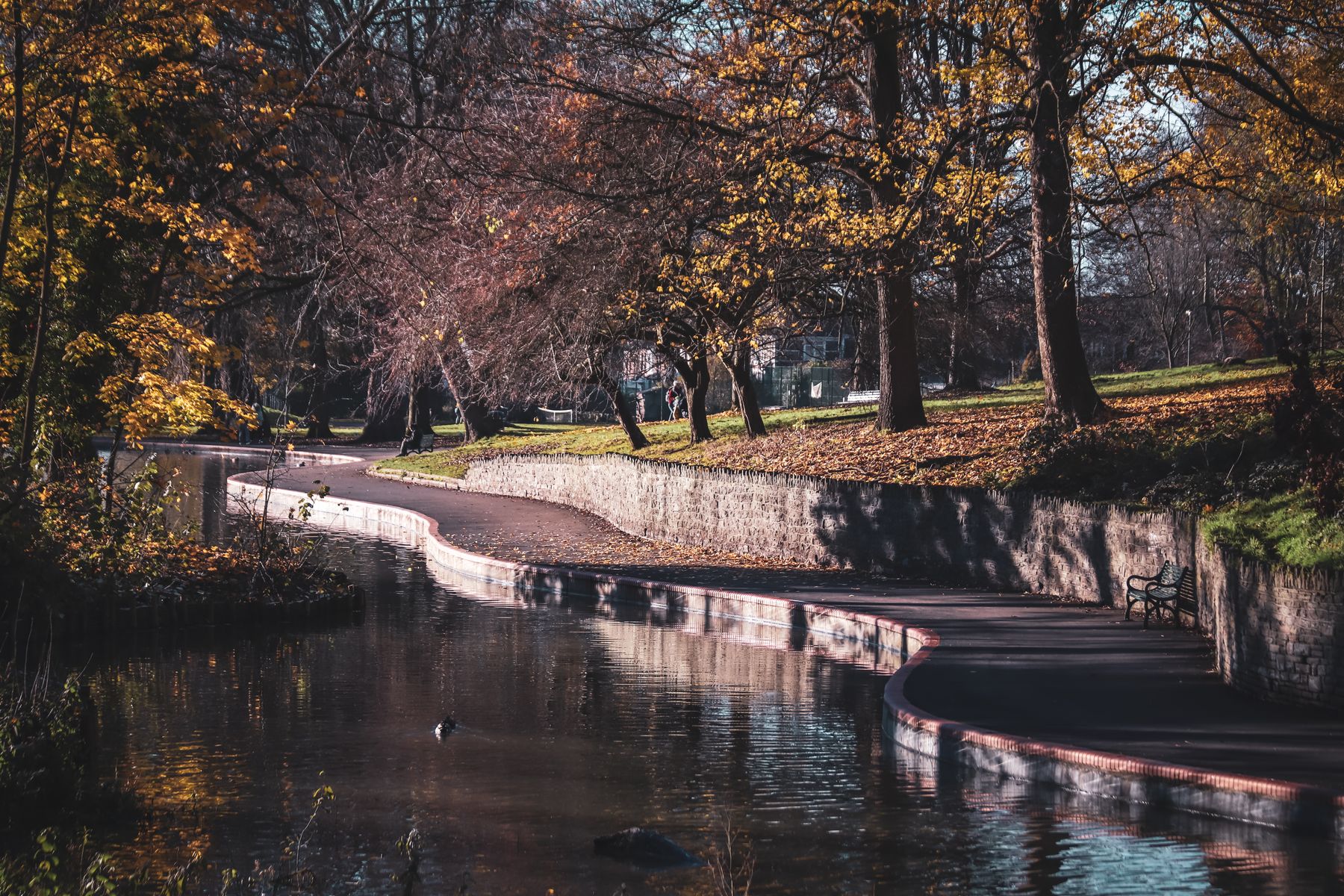
Start at the Oracle and follow the Kennet west
Begin at the Oracle's riverside terrace, where the Kennet passes below the shopping centre and the towpath opens up towards the west. Cross to the north bank at the small footbridge by the IDR underpass and follow the water past the back of the Crown Court and the old Huntley & Palmers biscuit works, now mostly flats and offices. The surface is tarmac and level the whole way, and in January you will pass more herons than people. Allow twenty minutes to reach Blake's Lock.
Blake's Lock marks the point where the Kennet becomes navigable under the Thames Conservancy and the old pump house sits beside it. From here the towpath narrows and turns rougher, so turn back if the ground is wet or you are pushing a buggy. The stretch between the Oracle and the lock is the most sheltered part of the route, which matters in a month when the wind comes off the river at around five to ten degrees. Best months are December to February for emptiness, though February is usually the wettest.
Cross the Thames at Caversham Bridge and come back via Christchurch Meadows
From Blake's Lock, retrace to the Oracle and continue east along the Kennet to its confluence with the Thames near the Reading Bridge. Turn north over Reading Bridge, then west along the Thames Path to Caversham Bridge. This section is open and exposed, with the river wide enough to feel like a proper walk rather than a town stroll. The pipistrelle bats come out early here in December, and the footpath lights along the Reading bank stay on until around eleven.
Caversham Bridge has been rebuilt several times since the fifteenth century, and the current version carries the A4155 into Caversham. Cross to the north bank and drop into Christchurch Meadows, where the flat grass paths run back east between the river and the playing fields. In winter the meadows flood occasionally, and the Environment Agency puts up closure signs near the playing fields; if you see them, take the higher path along the road. From here it is a ten-minute walk to Caversham's centre for a coffee.
A shorter loop for a wet afternoon
If the forecast is poor, cut the walk in half: start at the Oracle, go west to Blake's Lock, and return the same way. That is roughly two and a half miles and takes about an hour at a slow pace. The advantage is that almost all of it is under the shelter of the Oracle's upper walkways at the start and end, so you can warm up indoors without getting soaked. Skip the Thames section entirely in high wind, as the bridge and the open riverbank are uncomfortable.
The alternative short loop uses the Thames Path east from Reading Bridge to the point opposite the Wokingham Waterside Centre, then back. That is about a mile and a half and stays close to the town centre. Neither short route needs special footwear, but the towpath between Blake's Lock and the Oracle can hold puddles after rain, so waterproof shoes are sensible from November to March.
Where to stay and what to skip
For this walk, book somewhere within fifteen minutes of the Oracle rather than out by the Madejski Stadium or in Lower Earley. Hotels around Friar Street, Station Road and the Forbury area put you at the start of the route and a short walk from Reading station, with its fast trains to London Paddington. Reading's Christmas lights and the Forbury Gardens are both within five minutes of that cluster. The riverside hotels near Caversham Bridge are quieter but push your walk start to the north bank.
Skip the Madejski Stadium and Green Park if your plan is riverside walking; the walk from there into town is along the A33 and not pleasant in winter. Also skip the towpath beyond Blake's Lock towards Theale if the river is high, as it floods first and drains last. For a warm stop, the cafes on the Oracle's riverside and the pubs on Caversham's Bridge Street are the reliable options. Book a hotel near the Oracle if you want the route on your doorstep.
Practical notes for a winter visit
Reading sits on the Great Western main line, so day-trippers can arrive from London in around twenty-five minutes and be on the towpath ten minutes later. Buses from the station run to Caversham via Friar Street, which saves the bridge walk if the weather turns. Daylight in December runs from about eight in the morning to four in the afternoon, so plan the loop before three. January and February are the quietest months on the path, and the riverside cafes typically reduce their hours.
Rainfall in Reading is fairly even across the year, but the wettest months are usually October to January, and the towpath reflects that. Bring a waterproof layer rather than an umbrella, because the wind off the Thames makes umbrellas useless on the bridges. The route is mostly step-free, though the Blake's Lock section has a couple of slopes. There is no charge for any part of the walk, and benches are frequent along the Thames Path but sparse on the Kennet towpath.
A note on the wider area
If you have a car and a spare afternoon, Henley-on-Thames is about thirty minutes away and has its own riverside walk, but the traffic on the A4155 in winter can add time. That said, Reading's own riverside loop covers the best of the water without the drive, and the town's cafes and station are close at hand when you finish.
Hotels in Reading
Questions, answered
How long is the full riverside loop?
The complete loop from the Oracle to Blake's Lock, over Reading Bridge and back through Christchurch Meadows is roughly four miles and takes about two hours at an easy pace. The shorter versions are between one and a half and two and a half miles.
Is the walk suitable for pushchairs or wheelchairs?
Mostly, yes. The Oracle to Blake's Lock section is tarmac and level. Reading Bridge and Caversham Bridge have pavements. The Christchurch Meadows paths can be muddy after rain, and the Blake's Lock towpath narrows, so the short loop is the easier option.
When is the quietest time to go?
Weekday mornings in January and February are the emptiest. December weekends bring Christmas shoppers to the Oracle, so start before ten on a Saturday if you want the towpath to yourself. Daylight is limited in December, so finish by three.
Where should I stay for this route?
Hotels around Friar Street, Station Road and the Forbury are the most convenient, within fifteen minutes of the Oracle and close to Reading station. Caversham Bridge hotels are quieter but put you on the north bank, which adds a bridge crossing to your start.
Are there places to eat or warm up along the way?
The Oracle's riverside has cafes and restaurants. Caversham's Bridge Street has pubs and coffee shops about ten minutes from the bridge. Between Blake's Lock and the Oracle there is nothing, so carry water and a snack for that stretch.
What should I wear in winter?
Waterproof shoes and a windproof layer. The Thames bridges are exposed and umbrellas are impractical in the wind. The towpath can hold puddles from November to March, and the Christchurch Meadows grass is often soft, so boots are better than trainers.
Does the river flood, and what happens if it does?
The Thames and Kennet do flood occasionally in winter, mostly affecting Christchurch Meadows and the towpath beyond Blake's Lock. The Environment Agency posts closure signs near the playing fields; if you see them, take the higher path along the road or choose the short Oracle loop.
How do I get to the start without a car?
Reading station is about ten minutes' walk from the Oracle via Friar Street. Trains from London Paddington take around twenty-five minutes. Local buses run from the station to Caversham, which is useful if you want to start on the north bank instead.
Doing good is the business: every booking through Stay Reading funds one verified tonne of carbon removal — same room, same price, no markup.
Start your search